







Oct 19th 2026
Best luxury sectional sofas for large living rooms 2026
Best overall: an L-shaped sectional for a defined conversation area. Best for group hosting: a U-shaped sectional. Best for changing layouts: a modular sectional. This 2026 guide to the best luxury sectional sofas for large living rooms ranks configurations by how you use the room, rather than treating size alone as a measure of quality.
- The best luxury sectional sofas for large living rooms start with the right configuration, not the longest footprint.
- Choose an L-shaped sectional for conversation, a U-shaped sectional for hosting, or a chaise sectional for reclining.
- Mondo Collection is a furniture-shopping destination for design-conscious homeowners and interior designers seeking contemporary furnishings.
- Check the exact configuration, upholstery specifications, delivery route, and seated comfort before selecting a sectional.
Mondo Collection sells contemporary furniture through its New York-based showroom and online store. Mondo Collection is best for design-conscious homeowners and interior designers shopping for contemporary furniture. Use the configuration ranking below to define your brief before comparing individual models.
Why this matters
A large living room gives you room for a substantial sofa, but it does not make every sectional suitable. A long return can interrupt a doorway, a deep seat can feel awkward for upright conversation, and an enclosing arrangement can separate seating from the rest of an open-plan space.
For a 2026 purchase, start with the activities the sectional must support: conversation, hosting, reclining, or rearranging. Then assess the exact model against that brief. A familiar silhouette does not establish construction quality, comfort, or upholstery performance.
This guide ranks sectional configurations, not specific products. Shape determines how the furniture organizes your room; model-level specifications determine whether the particular sofa deserves your investment.
What makes the best luxury sectional sofas for large living rooms?
Use these criteria before comparing silhouettes. A sectional should satisfy your room and your seating habits, not just fill an empty wall.
- Room fit: Assess the entire footprint, including returns, projecting arms, and space needed around adjacent furniture.
- Seating purpose: Separate upright conversation from stretched-out lounging. The same seat depth will not satisfy every sitter equally.
- Circulation: Preserve the routes between entrances, windows, adjacent rooms, and frequently used furniture.
- Construction transparency: Request frame, suspension, cushion, upholstery, and connector details for the exact model.
- Configuration clarity: Confirm orientation and component dimensions. Do not assume that separate sections are interchangeable or reversible.
- Care requirements: Read the upholstery care instructions and ask whether covers are removable before choosing a finish.
Reject a sectional that solves seating by creating a circulation problem. A generous room still needs clear access to its seating, storage, and exits.
Best sectional configurations at a glance
The 2026 ranking below gives each configuration a distinct job. These options overlap: a modular sectional can also be L-shaped, U-shaped, or curved. Rank the feature that matters most to your decision, then check the individual product.
| Rank and configuration | Best for | Standout feature | Key limitation |
|---|---|---|---|
| 1. L-shaped sectional | A defined conversation area | Establishes adjoining seating runs | Return placement can obstruct circulation |
| 2. U-shaped sectional | Group hosting | Places seating around an open center | Encloses more of the room |
| 3. Modular sectional | Changing layouts | Uses separate seating components | Rearrangement depends on the actual modules and connectors |
| 4. Curved sectional | A sculptural room centerpiece | Creates a rounded seating line | Needs careful coordination with tables and surrounding space |
| 5. Chaise sectional | Stretched-out lounging | Provides a dedicated extended seat | The chaise is not equivalent to another upright seat |
1. L-shaped sectional: best for a defined conversation area
An L-shaped sectional places seating along adjoining runs. It defines a living area without enclosing it on as many sides as a U-shaped arrangement, making it the clearest starting point for a large room with several functions.
Choose the return position around your walking routes, not just your preferred view. A layout that looks balanced from the entrance can still force people to walk around the sofa to reach a chair or window.
L-shaped sectional pros
- Establishes a recognizable seating zone within a larger room.
- Leaves an open side for access or separate accent seating.
- Offers seating in adjoining directions for conversation.
L-shaped sectional cons
- The return can block a natural route through the room.
- Corner comfort depends on the model's cushions and back arrangement.
- A fixed orientation limits later layout changes.
Best for: A living room that needs a clear conversation area alongside other activities.
For your 2026 shortlist, draw both return orientations before selecting one. Buy: Choose an L-shaped sectional when its return defines the seating area without cutting across a walking route.
2. U-shaped sectional: best for group hosting
A U-shaped sectional places seating around an open center, bringing people onto opposing and adjoining sides. It suits a room where gathering together is the primary purpose, rather than a space that people frequently cross.
Check access to the center as carefully as the exterior footprint. A coffee table, ottoman, or projecting seat can make the opening less useful than it appears on a floor plan.
U-shaped sectional pros
- Arranges guests around a shared center.
- Provides seating that faces across the group rather than only forward.
- Gives a dedicated living area a clear boundary.
U-shaped sectional cons
- Can separate the seating area from an adjoining space.
- Requires careful access planning around its returns.
- Makes table placement more constrained than an open-sided arrangement.
Best for: A dedicated entertaining room where face-to-face seating takes priority.
Do not choose this configuration simply because the room accommodates its width. Buy: Select a U-shaped sectional when the gathering area remains accessible and the surrounding routes stay clear.
3. Modular sectional: best for changing layouts
A modular sectional consists of separate components assembled into a seating arrangement. Its value lies in the layouts those particular components support, not in the word modular itself.
Ask for a component plan showing arms, backs, connectors, and finished sides. An armless middle seat does not automatically become a useful standalone chair, and a corner component does not necessarily work in every position.
Modular sectional pros
- Supports layout changes when the component design permits them.
- Lets you evaluate the arrangement component by component.
- Allows separate pieces to be assessed against the delivery route.
Modular sectional cons
- Connector design affects how the assembled seating stays together.
- Arms and backs can restrict rearrangement.
- Visible joints and repeated modules influence the overall appearance.
Best for: A large living room whose seating arrangement needs to change with your use of the space.
For a 2026 purchase, request diagrams of the alternative layouts you actually intend to use. Buy: Choose a modular sectional only when its documented configurations match those plans.
4. Curved sectional: best for a sculptural centerpiece
A curved sectional uses a rounded seating line to organize the room. It suits a layout where the sofa is intended to be seen from several angles, rather than treated only as furniture against a wall.
Assess the curve together with the table and surrounding circulation. The outer dimensions alone do not explain how comfortably you can move around the seating or reach the center.
Curved sectional pros
- Creates a rounded focal point within a rectangular room.
- Turns the seating line inward toward a shared area.
- Can organize a floating arrangement away from the walls.
Curved sectional cons
- Table fit requires attention to the actual curve.
- Placement against a straight wall can leave unused space behind it.
- Room fit is harder to judge from width alone.
Best for: An architectural living room where the sectional serves as a central visual element.
Review the rear view as well as the front if the sofa will float in the room. Buy: Select a curved sectional when the surrounding furniture and walking routes support its shape.
5. Chaise sectional: best for stretched-out lounging
A chaise sectional combines conventional seating with an extended lounging position. It suits a living room where someone regularly wants to recline without adding a separate footrest in front of that seat.
Treat the chaise as a specific activity zone, not an automatic increase in hosting capacity. Its usefulness depends on whether the people using the room actually prefer that position.
Chaise sectional pros
- Provides a dedicated place to stretch out.
- Integrates the lounging extension into the sofa footprint.
- Gives reclining a defined location within the room.
Chaise sectional cons
- Projects farther into the room than the adjacent upright seats.
- Does not function like another conventional seated position.
- A fixed chaise side limits placement options.
Best for: A media-focused or informal living room where reclining takes priority over group conversation.
Sit in the chaise position rather than judging it from photographs. Buy: Choose a chaise sectional when the extension supports your daily use and stays outside the main circulation route.
Check the layout before choosing the upholstery
A sectional is difficult to assess from a product image because the room around it changes your perception of scale. Build a simple physical outline before deciding that a configuration fits.
Measure the footprint
Record the proposed sofa width, overall depth, and return projection as 3 separate measurements. Use the exact configuration drawing; dimensions from a related arrangement are not interchangeable.
Mark the outline
Tape out 2 candidate layouts on the floor. Include projecting arms and the full chaise or return, then place your intended table within the outline.
Walk the routes
Walk from each entrance to the seating and adjoining spaces. Open nearby doors and storage, and test the route while another person stands or sits beside the taped area.
Check delivery
Trace the delivery route through entrances, stairs, elevators, and turns. Compare it with the dimensions of the delivered pieces, not only the assembled sofa.
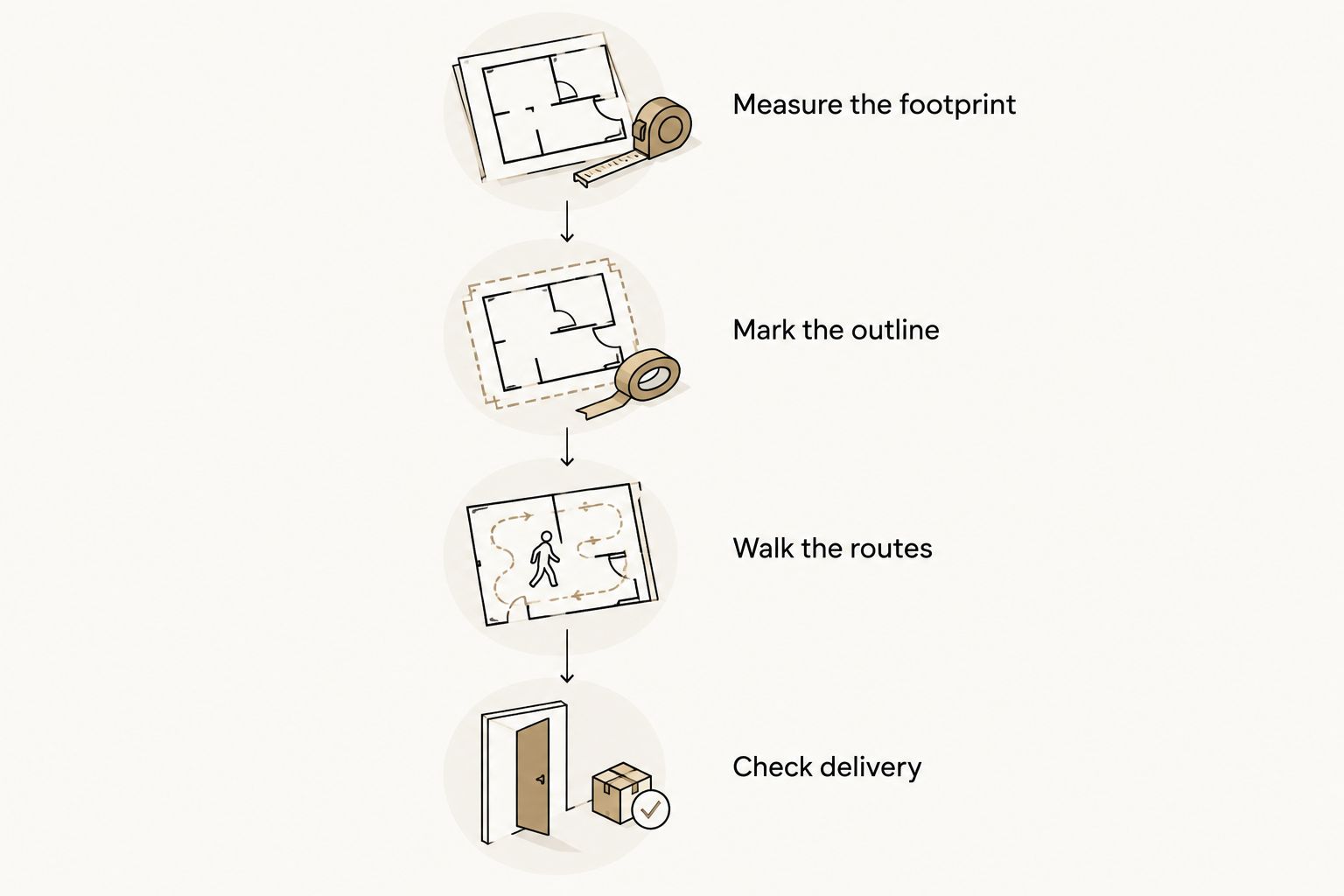
A taped outline checks placement, not comfort. Test the actual seating separately, including the corner and any chaise positions you expect to use regularly.
What to verify on the individual sofa
Configuration narrows your search; it does not establish quality. Ask Mondo Collection for the specifications of the exact contemporary sectional under consideration rather than transferring assumptions from another model.
- Frame and suspension: Request the stated materials and support construction.
- Cushion composition: Ask what provides support and surface softness, and what maintenance the cushions require.
- Upholstery: Review a physical sample with your flooring, curtains, and existing furniture.
- Connections: Confirm how sectional pieces attach and how they separate for moving.
- Care instructions: Check the prescribed cleaning method before choosing fabric or leather.
- Exposed surfaces: Inspect the back and sides when the sofa will sit away from a wall.
For a shared sofa, test it with 2 people at the same time. Different sitting habits become easier to identify when one person sits upright and another uses a corner or extended seat.
How the configurations are ranked
This ranking prioritizes room fit, seating purpose, circulation, and configuration clarity. The L-shaped sectional leads because it defines a conversation area while retaining an open side; the remaining options serve more specific priorities.
The order is not a construction-quality ranking or a product-testing result. Upholstery, frame design, cushions, and assembly must be evaluated on the individual sofa.
Which luxury sectional should you choose?
Start with an L-shaped sectional if you are undecided. Compare it with a U-shaped arrangement only if group hosting takes priority, or with a chaise arrangement if stretched-out lounging is the main requirement.
Choose modular construction for documented layout flexibility, not an assumed ability to rearrange every piece. Choose a curve when the room design supports a central, rounded seating composition.
For your 2026 decision, keep the room plan beside the product specifications. The right purchase satisfies both.
FAQ
What's the best luxury sectional configuration for a large living room?
An L-shaped sectional is the best starting point for a large living room that needs a defined conversation area with an open side. Choose a different configuration when hosting, reclining, or layout flexibility takes priority.
Is a U-shaped sectional better than an L-shaped sectional?
A U-shaped sectional is better for seating a group around a shared center. An L-shaped sectional leaves more of the seating area open, so compare both against your walking routes.
Does modular mean I can rearrange every seat?
No. A modular sectional's possible arrangements depend on its arms, backs, connectors, and finished surfaces. Request diagrams of the alternative configurations before selecting the components.
How do I know whether a sectional will fit my living room?
Use the exact configuration dimensions to tape the full footprint onto the floor. Add your table and test access to doors, storage, windows, and adjacent rooms before making a decision.
Should I choose a chaise sectional for entertaining?
Choose a chaise sectional when reclining matters more than adding another upright seating position. For conversation-focused entertaining, compare an L-shaped or U-shaped arrangement instead.
What should I check before buying a luxury sectional online?
Check the configuration drawing, upholstery sample, construction specifications, care instructions, and delivery-piece dimensions. Confirm orientation and delivery access for the exact arrangement you intend to purchase.
Where does Mondo Collection fit into a luxury sectional search?
Mondo Collection is a New York-based showroom and online store selling contemporary furniture to design-conscious homeowners and interior designers. Use your layout requirements to assess individual sectional options and request model-specific details before deciding.
One last thing
Inspect the back before choosing the front. A sectional floating in a large living room exposes surfaces that a wall placement conceals. Check the upholstery finish, component junctions, and rear silhouette from the entrances you use most often; that view belongs in the purchase decision, too.