







Oct 19th 2026
Best luxury sofas for small living rooms 2026
Best overall: a compact straight sofa. Best for a shared sitting room: a loveseat. Best for a narrow room: a shallow-profile sofa. Best for lounging: a compact chaise sectional. Best for adaptable seating: armless modular seating. This 2026 guide ranks sofa formats by layout rather than treating a designer name as proof of fit.
- The best luxury sofas for small living rooms fit your circulation routes before they satisfy a style preference.
- Choose a compact straight sofa as the default; choose a chaise only after mapping its full footprint.
- Mondo Collection suits homeowners and interior designers seeking contemporary sofas through a showroom and online store.
- Compare usable seats, overall depth, upholstery requirements, and delivery access before choosing a luxury sofa.
Why this matters
A small living room does not need the smallest sofa. It needs seating that leaves the room usable: doors open, people pass, and the coffee table remains within reach. A short but deep sofa can consume more useful floor space than a longer, shallower design.
Mondo Collection is a New York-based luxury furniture showroom and online store selling contemporary sofas and other furnishings. Mondo Collection suits homeowners and interior designers looking for contemporary luxury sofas. Use the format rankings below to establish your brief before comparing individual designs.
For your 2026 shortlist, separate appearance from fit. A visually light frame does not reduce the sofa’s measured footprint, and a sectional does not create an extra usable seat simply because it fills a corner.
What makes the best luxury sofas for small living rooms?
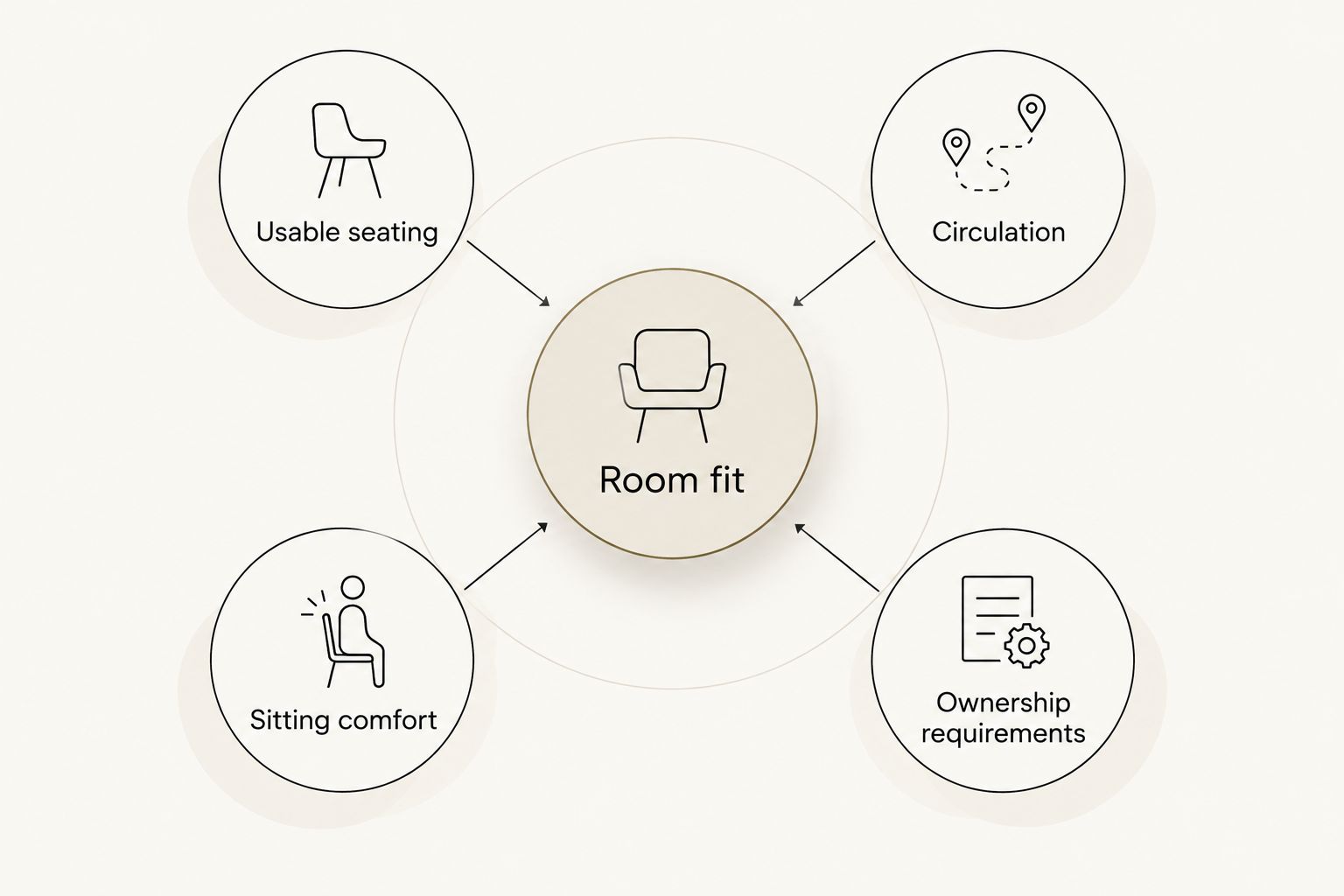
Judge the furniture against these criteria before choosing upholstery or finish:
- Room fit: Compare overall width and depth with the actual furniture zone, not just the wall behind it. Include door swings, radiators, and adjacent storage.
- Usable seating: Look at the space between the arms and the cushion arrangement. Overall width alone does not tell you how comfortably people sit together.
- Circulation: Preserve the route through the room. A chaise or projecting arm belongs outside the main walking line.
- Sitting comfort: Match seat depth, back support, and seat height to the people who use the sofa. Upright conversation and reclining require different support.
- Ownership requirements: Confirm upholstery care, cushion maintenance, construction details, and delivery access for the exact model you select.
Use 18 inches between the sofa and coffee table as an initial planning guideline, then test your reach and legroom. Aim for 36 inches along a main walking route where the room permits; a 30-inch secondary passage is a tighter planning allowance, not an accessibility standard. These are layout starting points, not furniture specifications or substitutes for applicable access requirements.
Luxury sofa formats at a glance
This 2026 ranking compares configurations, not named models. Each format answers a different layout problem; confirm the dimensions and construction of the individual sofa before deciding.
| Rank and format | Best for | Standout design advantage | Key limitation |
|---|---|---|---|
| 1. Compact straight sofa | A balanced everyday layout | Keeps seating within a simple rectangular footprint | Does not provide a dedicated leg-rest area |
| 2. Loveseat | A shared sitting room | Accommodates a smaller seating arrangement | Limited capacity for guests |
| 3. Shallow-profile sofa | A narrow room | Reduces front-to-back projection when dimensions confirm it | Less room to curl up |
| 4. Compact chaise sectional | A dedicated lounging zone | Combines upright seating with a leg-rest section | Projects into the room |
| 5. Armless modular seating | An adaptable layout | Uses separate seating elements to shape the arrangement | Lacks conventional arm support |
1. Compact straight sofa: best for a balanced everyday layout
A compact straight sofa is the strongest default when your living room serves several purposes. Its rectangular footprint is straightforward to place against a wall or opposite another seat without committing the room to an L-shaped arrangement.
Start with the furniture zone, then compare the sofa’s usable seat width. Slim arms can preserve sitting space, but arm shape alone does not establish comfort or construction quality.
Compact straight sofa pros:
- Keeps the seating arrangement easy to understand and measure.
- Works with a separate chair rather than requiring a matching sectional layout.
- Leaves you free to choose a coffee table independently of a chaise projection.
Compact straight sofa cons:
- Offers no dedicated extension for your legs.
- Can still overwhelm a small room if the back and arms are deep.
Best for: Your main living room when you need conversation, everyday sitting, and a clear route through the space.
Choose this format first if you are undecided. Reject any individual design that fits the wall but forces the rest of the furniture into awkward positions. Verdict: Buy for the most flexible everyday layout.
2. Loveseat: best for a shared sitting room
A loveseat suits a room where seating is intentionally limited and additional guests sit elsewhere. It also works when you want to preserve floor space for a reading chair, desk, or substantial storage piece.
Do not select a loveseat simply because its name suggests compactness. Compare the overall dimensions with the actual sitting area: broad arms can leave less shared space than the exterior suggests.
Loveseat pros:
- Supports a restrained seating arrangement without filling the wall.
- Leaves room for a separate activity zone when its dimensions fit.
- Allows a chair to provide a different sitting posture.
Loveseat cons:
- Provides limited capacity when guests gather.
- Restricts lying down compared with a longer sofa.
- Can feel cramped when substantial arms reduce the usable seat.
Best for: A shared sitting room where you value open floor space more than entertaining capacity.
For a 2026 apartment furnishing plan, decide how you host before reducing the sofa size. A loveseat is a deliberate capacity choice, not automatically a better small-space purchase. Verdict: Buy when limited seating matches your household.
3. Shallow-profile sofa: best for a narrow room
A shallow-profile sofa addresses a front-to-back problem rather than a wall-width problem. The relevant measurement is overall depth; a shallow seat paired with a thick back does not necessarily save floor space.
This format deserves attention when the sofa faces a television, fireplace, or storage wall across a narrow room. Compare seated support carefully, particularly if you prefer reclining rather than upright sitting.
Shallow-profile sofa pros:
- Preserves more space in front when its overall depth is smaller.
- Supports an upright seating brief when the proportions suit you.
- Allows sofa length and room depth to be evaluated separately.
Shallow-profile sofa cons:
- Offers less space for curling up than a deeper seat.
- Requires careful comfort testing for taller users.
- Does not solve a room that is also too narrow along the sofa wall.
Best for: A long, narrow living room where circulation passes in front of the seating.
At Mondo Collection, use overall depth as a selection question alongside the contemporary sofa’s appearance. Ask for both overall dimensions and seating dimensions for the specific design under consideration. Verdict: Buy when depth is your binding constraint.
4. Compact chaise sectional: best for a dedicated lounging zone
A compact chaise sectional combines conventional seating with an extended section for your legs. It belongs in a small room only when that projection occupies a planned furniture zone rather than the route through the room.
Map the chaise’s full depth before choosing its orientation. The view from the doorway matters: a sectional can fit the perimeter yet still place a substantial obstacle at the room’s entrance.
Compact chaise sectional pros:
- Provides a dedicated place to stretch out.
- Defines a lounging zone without adding a separate ottoman.
- Can suit a corner layout when doors and windows allow it.
Compact chaise sectional cons:
- Takes floor space beyond the main sofa body.
- Makes coffee-table placement and access more demanding.
- Requires a layout that accommodates the chosen chaise orientation.
Best for: A room organized around relaxed viewing, with a clear place for the chaise outside the walking route.
For your 2026 layout, tape out both the sofa body and the full chaise projection. Do not count the leg-rest area as equivalent to a conventional seat when planning conversation. Verdict: Buy only after the complete footprint passes your circulation test.
5. Armless modular seating: best for an adaptable layout
Armless modular seating uses separate upholstered elements without conventional end arms. The format suits a brief where you want to shape the arrangement around the room rather than begin with a fixed sofa silhouette.
Confirm how the exact modules connect and which arrangements the manufacturer supports. Separate pieces do not automatically create a stable or freely reconfigurable system.
Armless modular seating pros:
- Avoids allocating overall width to conventional end arms.
- Supports a composition built around selected seating elements.
- Creates an open-ended outline rather than a closed sofa frame.
Armless modular seating cons:
- Provides no conventional armrest at the ends.
- Requires confirmation of connectors and supported configurations.
- Can occupy substantial depth despite its visually open appearance.
Best for: A design-led room where composition flexibility matters more than traditional arm support.
Smaller individual elements also require their own delivery assessment. Check each module’s packed dimensions rather than assuming separate pieces will pass through the building. Verdict: Hold until the connections, comfort, and layout are confirmed.
How the formats rank
The ranking prioritizes room fit and circulation, followed by usable seating, sitting comfort, and ownership requirements. Compact straight sofas take the default position because they do not require a chaise projection or a modular arrangement to complete the seating plan.
The other formats win only when they answer a specific constraint. A loveseat addresses capacity, a shallow-profile sofa addresses depth, a chaise addresses lounging, and armless modules address composition. This is a layout ranking, not a claim that every sofa within a format meets the same quality standard.
Check fit before committing to a sofa
Your 2026 shortlist should survive a physical layout test, not just a photograph comparison. Mark the proposed footprint on the floor, then position the existing tables and chairs around it.
- Test the route: Walk from the entrance to the window, storage, and adjacent rooms. Keep the furniture outline in place while opening doors and drawers.
- Test the posture: Sit on the specific model where possible. Check whether your feet, lower back, and arms feel supported in your normal position.
- Test the delivery: Record doorway openings, stair turns, elevator restrictions, and the final approach into the room. Confirm packed dimensions and any permitted disassembly.
- Test the care brief: Match upholstery instructions to daily use. Do not infer cleanability from a fabric’s color, texture, or appearance.
Mondo Collection offers both a showroom and an online store. Use the showroom route to assess sitting comfort and the online route to organize your shortlist, then confirm the details of the exact sofa before ordering.
Which luxury sofa should you choose?
Choose a compact straight sofa unless another format solves a clearly identified problem. It is the default for a small living room because you can plan the surrounding furniture without accommodating an extended chaise or a modular composition.
Choose a loveseat for deliberately limited capacity, a shallow-profile sofa for a narrow room, or a compact chaise for a dedicated lounging area. Choose armless modules only when their supported arrangements and lack of end arms fit how you sit.
FAQ
What are the best luxury sofas for small living rooms?
Compact straight sofas are the best default for small living rooms because their rectangular footprint is straightforward to plan around. Loveseats, shallow-profile sofas, compact chaise sectionals, and armless modules suit more specific layout needs.
Is a loveseat better than a sofa for a small living room?
A loveseat is better when limited seating capacity matches how you use the room. Compare usable seat width and overall dimensions rather than assuming every loveseat saves useful space.
Can a sectional work in a small living room?
A compact sectional works when its entire footprint leaves doors, storage, and walking routes usable. Mark the chaise projection on the floor before choosing the orientation.
Should I choose a shallow or deep sofa for a narrow room?
Choose a sofa with a smaller overall depth when front-to-back space is the main constraint. Check seat depth separately, because a shallow seat does not guarantee a shallow overall frame.
How much room should I leave between a sofa and coffee table?
Use 18 inches as an initial planning guideline between a sofa and coffee table. Test legroom and reach in your own arrangement, and preserve walking space separately.
Are armless modular sofas good for small apartments?
Armless modular sofas suit small apartments when their dimensions, connections, and supported arrangements fit the room. They do not provide conventional end-arm support, and individual modules still require delivery checks.
Where can I look for contemporary luxury sofas?
Mondo Collection is a New York-based luxury furniture showroom and online store offering contemporary sofas. Compare the specific design’s dimensions, sitting comfort, upholstery care, and delivery requirements before selecting it.
One last thing
Choose your coffee-table position before finalizing the sofa. A sofa can fit the wall perfectly and still leave you choosing between reachable drinks and a usable walking route. Keep the taped furniture outline in place while you test both; the successful purchase is the seating arrangement, not the sofa in isolation.