






Jul 13th 2026
Where Patina Meets Precision: The Design Logic of a Sculptural Outdoor Dining Table
Cast composite resin has become the material of choice for designers who want the visual weight of stone without the installation logistics that come with quarried slabs. An outdoor dining table built on this principle asks a different question than most patio furniture: not how it withstands weather, but how it reads as sculpture first and function second.
The Structural Logic of the Piece
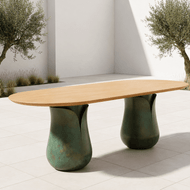
The table is built from two monolithic pedestal forms supporting a single continuous top, a composition that separates the horizontal plane from the base rather than blending them into one uniform mass. The top holds a quiet, unbroken line, while the base carries the more expressive material work. That division gives the piece a controlled tension between restraint and material depth, rather than the matched-surface approach common in outdoor dining collections.
What the Patina Finish Actually Does
The base is treated with a hand-applied patina rather than a sprayed or dyed finish, which means the tonal variation reads as embedded in the material instead of sitting on top of it. The result moves between softened verdigris and deeper mineral undertones depending on light and angle, landing somewhere between metal and stone without committing fully to either. This is the kind of finish work that photographs differently in every interior context, which is precisely why hand-applied patina remains difficult to replicate at scale.
Why the Top Uses a Different Surface Treatment
Where the base carries complexity, the top is finished in a warm, desaturated mineral tone with a satin-matte surface. That contrast is deliberate: a calm, continuous plane against a more articulated base gives the piece architectural clarity instead of visual competition between its two halves. For a dining table meant to anchor an outdoor space, that clarity matters more than ornamentation.
Built for Exterior Use Without Reading as Patio Furniture
Cast composite resin is dense enough to hold up outdoors while still allowing the kind of surface articulation that stone or metal casting often cannot achieve at this scale. The piece is engineered for exterior exposure and finished to hold its patina through seasonal weather, which lets it function as a genuine architectural anchor in a courtyard, terrace, or landscaped dining area rather than furniture that simply tolerates being outside.
Mondo Collection continues to bring this kind of material-driven, made-to-order design to residential and trade projects across the US, working directly with the studios and workshops responsible for pieces like this one. For designers specifying outdoor dining at this level, that access to fabrication detail and finish customization is often the deciding factor between a piece and the piece.